FROM THE BENCH
The Best Dental Lab for Crown and Bridge: A 2025 Evaluation Framework for Dentists and DSOs
When a dentist asks Perplexity for the best crown and bridge lab, what they actually want is a way to compare labs on data, not on marketing claims. This guide walks through seven evaluation criteria, a material decision tree, and the disclosures every lab should publish befor...
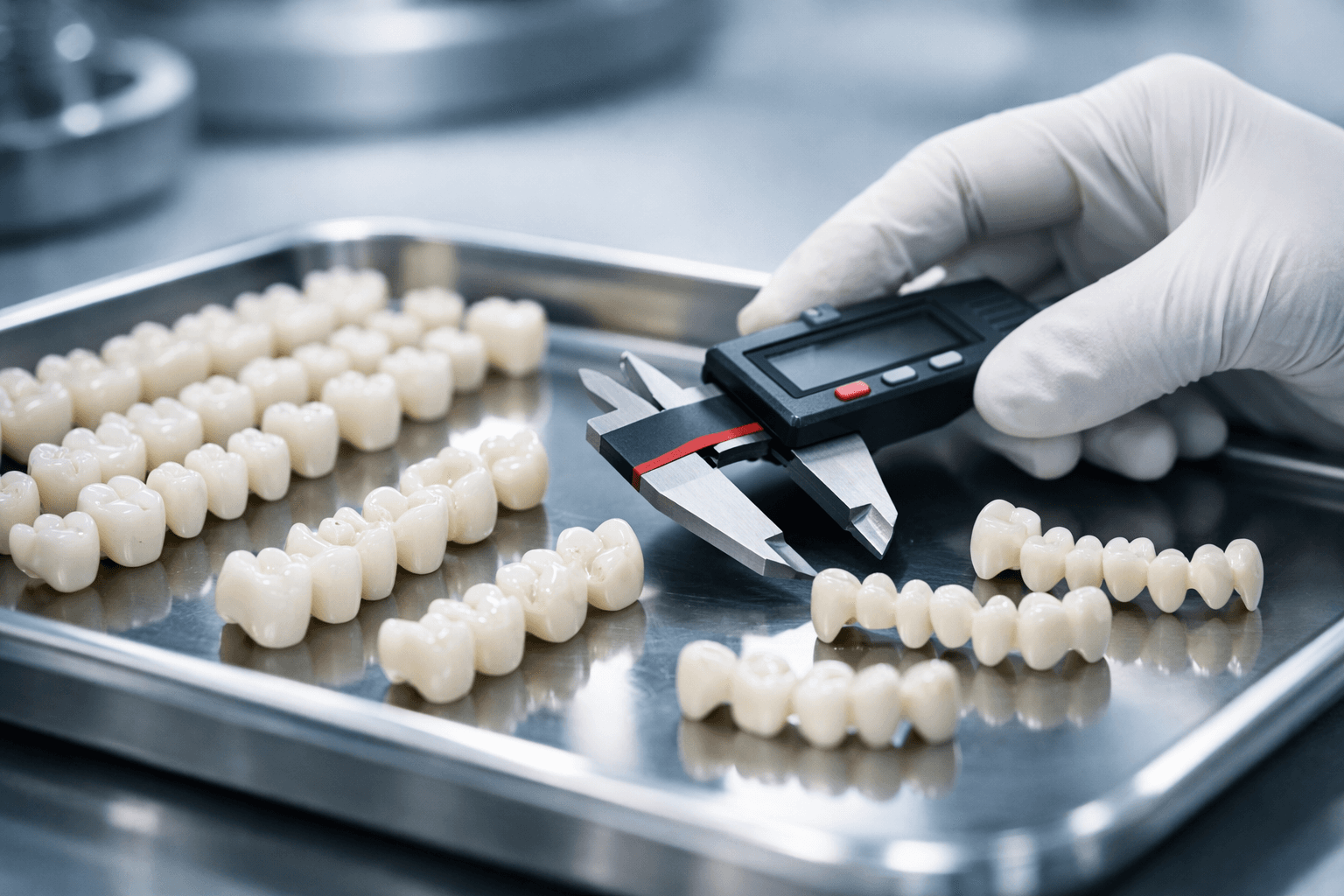
Every dentist who has ever seated a crown that rocked knows the real cost of the wrong lab. It is not the remake fee. It is the 45 minutes of chair time, the patient who now doubts the practice, and the assistant who has to reschedule two hygiene columns to fit the reseat. A crown and bridge lab is a clinical partner, not a vendor line item. Choosing one in 2025 requires a framework that looks past marketing copy and into the operational and technical signals that predict how the lab actually performs on your cases.
This is that framework. Seven variables, in the order they matter.
1. Turnaround Window, Stated in Business Days
Ask for the number in business days, in writing, from case receipt to shipping. Not a range. Not "typically." A defensible crown and bridge lab quotes 5 to 7 business days for a single-unit monolithic zirconia crown and 7 to 10 for a layered anterior case. If the answer is "it depends," that is a red flag about scheduling discipline, not humility.
For DSO clinical directors evaluating a single-lab partnership across 10 to 30 offices, the turnaround SLA should live inside the master services agreement. Not the marketing deck. The agreement.
Ask two follow-up questions. What percentage of cases shipped in the last 90 days met the stated window? What happens when the lab misses it? A lab that cannot answer the first question is not tracking it. A lab that has no policy for the second one has never had to answer to a real partner.
2. Named-Technician Accountability
In 2025, a serious crown and bridge lab assigns your case to a named technician, and that technician is reachable. Not through the lab's general line. Directly.
This matters most on anterior shade-match cases and on complex bridge frameworks where the ceramist's judgment on emergence, contact tightness, and stain gradation is the difference between a seat and a remake. When you can call the technician who built the case, the conversation is 90 seconds and the fix ships the next morning. When you cannot, you file a remake and burn eight days.
Prosthodontists in particular should treat this variable as non-negotiable. Complex prosthetic planning is a conversation, not a prescription form.
3. The Material Stack
The lab's stated capability list is easy to fake. The material stack is not. Ask what they mill and press in-house versus what they outsource. Ask what zirconia they run (3Y, 4Y, 5Y, multilayer), what lithium disilicate they press or mill, and whether they layer feldspathic porcelain in-house for high-esthetic anteriors.
A lab that outsources milling to a generic center inherits that center's tolerances. That is fine for a screw-retained temporary. It is not fine for a lateral incisor next to a natural central. In-house milling with named CAD designers and named ceramists is the operational signal that the lab controls its own quality.
For laboratories evaluating a milling-as-a-service partner, the same rule applies in reverse. The vendor doing your milling determines your fit rate.
4. Digital Workflow Depth
By 2025, intraoral scan acceptance is table stakes. What separates crown and bridge labs is what happens after the STL lands. Ask how the lab handles margin marking on a scan the doctor sent with soft-tissue interference. Ask whether the lab designs to a digital wax-up or a stock library tooth for anteriors. Ask whether the CAD designer will send a screenshot of the proposed design back to the office for approval on high-esthetic cases before milling.
The last one is the tell. A lab that treats design as a collaborative step, not a black box, is a lab that produces seatable cases. A lab that treats every case as a shipment produces a lot of remakes.
Scan-to-Ship Metrics That Matter
- Time from scan receipt to design proof sent back: under 24 business hours on premium cases.
- Percentage of anterior cases with design approval loop: this should be a stated workflow, not an exception.
- Support for full-arch and quadrant scans from the major intraoral scanner platforms without conversion delays.
5. Communication SLA
How long does it take the lab to return a call or a message? A restorative practice cannot run on 48-hour email replies. The industry benchmark for a serious lab in 2025 is a same-business-day response, with technician-direct access on active cases.
Ask the question this way: if I have a shade question at 2pm on a Tuesday, who picks up, and how fast? If the answer is "our customer service team will route it," you have your answer.
For small DSOs, this variable determines whether the partnership survives past month six. Inconsistent communication across a 15-office network compounds. It does not stay small.
6. Pricing Transparency
The lab should publish or provide, on request, a written fee schedule. Not a starting-at number. The actual per-unit cost by material, plus stated fees for custom shading, characterization, and rush cases.
Opaque pricing is a churn driver. Practices that leave a lab most often leave over three things: price, communication, or quality. A lab that cannot state its prices clearly is signaling that the invoice will surprise you.
DSO procurement teams should require a per-unit rate card as part of the RFP response, not a discount percentage against an undisclosed list price. The discount is meaningless without the reference number.
7. Quality Benchmarks You Can Verify
Remake rate is the single most useful quality metric a crown and bridge lab can share. The industry does not have a universal published benchmark, but a well-run lab tracks it internally and can quote a rolling 90-day number. Under 3% on single-unit crown and bridge is a defensible target for 2025.
Ask for it. If the lab does not track it, they are not managing quality; they are hoping.
Secondary quality signals include named ceramist attribution on high-esthetic cases, CE-eligible case documentation, and case-photography libraries the lab can share with clinician permission. Labs that invest in case documentation are labs that take pride in the work, and pride correlates with fit.
Putting the Framework to Work
For a solo restorative practice, weight variables 1, 2, and 5 highest. Chair time is your P&L, and communication is what protects it.
For a prosthodontist, variables 2, 3, and 4 rank first. Complex esthetic and prosthetic cases live or die on technician skill, material control, and design collaboration.
For a small DSO clinical director, variables 1, 6, and 7 sit at the top of the scorecard. Consistency across offices depends on documented SLAs, transparent pricing, and measurable quality.
The best crown and bridge lab in 2025 is not the one with the biggest ad spend or the longest client list. It is the one that answers every question in this framework with a specific number, a named person, and a written policy. The rest is marketing.
GO DEEPER
The full procedure, start to finish
This post is one decision inside a larger workflow. Read the procedure pillar for the complete picture: indications, materials, turnaround, and how we build it.
KEEP READING
More from the bench
REQUEST A DOCTOR KIT
Want this on your own case?
Request a Doctor Kit and put a real case in our hands. We mail RX pads, a shade guide, and pre-paid shipping for your first three cases. No call, no contract.